I thought I'd share a paper written for one of my classes, reflecting just a bit on Thomas a Kempis' The Imitation of Christ.
A couple of years ago I was given an old copy of The Imitation of Christ from an elderly friend, who was a retired minister. It’s a paperback from the 1950’s and includes some simple but rather beautiful artwork. I’ve looked forward to the opportunity to read it and was glad to see this book as an option for class. I found The Imitation of Christ to be the timeless spiritual classic that it promised to be. It is full of wisdom in bite-sized chunks that leads naturally to self-examination and reflection. A Kempis is concerned with how life is lived out for the earnest follower of Jesus and he addresses both external action and internal states of the heart. His writings each have a descriptive title, and each entry is short and to-the-point.
Reading a Kempis reminds me of reading the biblical book of Proverbs. It reads like wisdom literature and contains plenty of wise instruction. The Imitation of Christ is the kind of book that can be read over and over with new insights and applications each time. It is not, however, a book of sentimentality or easy advice. A Kempis calls his readers to follow Jesus as one who called his disciples to take up a cross. True imitators of Christ are much fewer than those who claim to believe in him. He writes, “Jesus hath many lovers of His kingdom of heaven, but He hath few bearers of his cross. Many desire His consolation, but few desire His tribulation. He findeth many fellows at eating and drinking, but He findeth few that will be with Him in His abstinence and fasting. All men would joy with Him, but few would anything suffer for Christ.”
A Kempis has broken down his writings into four books: Admonitions Useful for a Spiritual Life, Admonitions Tending to Things Internal, The Inward Speaking of Christ to a Faithful Soul, and Concerning the Sacrament. The breadth of his writing is part of what makes his work such a valuable and beloved classic. He tends to the state of the mind and the soul, and to gaining peace with God. He talks of judgment and of grace. He talks of discipleship and temptation and trust. I found that his words are as profound as they are brief in each small section, and that I could ponder even one short section for a long time.
While I hesitate to voice anything that could be construed as criticism of such a classic, I will comment on the places where I didn’t find The Imitation of Christ to be helpful. A Kempis has a strong sense of God’s judgment and a somewhat frightening view of who will come out on the worse side of it on that day. The paradox of God’s grace and judgment in the scripture is perhaps reflected in the paradox of his writing, but when he talks of judgment it is very strong. A Kempis also admonishes followers of Christ to keep their distance from “worldly-living people.” While I can understand the purpose of his intent, I also feel a sense of contradiction. How can one imitate Christ, who was always in trouble for spending time with “worldly-living people,” and also diligently avoid such people? His separatism almost rings of elitism and I find it a bit troubling.
I greatly appreciate A Kempis for not painting an easy path of discipleship and for reminding those who would follow Christ of the difficulties that calling entails. At the same time, I find him to be a bit ascetic, inviting hardship where it may not be necessary. I also realize that I make that observation from a life of ease and I recognize my own need to hear his challenge in that regard. I am not sure if I’ve met more than a few people in all of my life who have understood what it truly means to take up a cross and follow Jesus. I know that I have not truly begun to sacrifice anything for Christ, and I am surrounded by a Christianity that spiritualizes suffering and hardship, and knows little of the life of the cross that is tangible and gritty.
“At the day of judgment it shall not be asked of us what we have read, but what we have done: nor how well we have said, but how religiously we have lived.” With all great admonitions to live well there is the risk of somehow subtracting from God’s grace and making our own efforts at living central to the faith, rather than the work of Christ. Bonhoeffer struggled with this even after writing The Cost of Discipleship, recognizing the danger in his work but also the need of it. I sense that same tension with a Kempis, and I appreciate it. I think it is the tension that we live in following Christ, being both recipients of his grace and of his call to take up our cross.
Wednesday, April 25, 2007


Monday, April 02, 2007
Theology IS Important!
It saddens me that there is such widespread disdain for theology in the church. Theology is often viewed negatively and is regarded as boring, uppity, irrelevant, and perhaps intimidating. Many believe that only really smart people can even approach theology, and that it’s to the detriment of their faith when they do. I find this very frustrating. When Dietrich Bonhoeffer spent some time in the United States he observed that American Protestantism was seriously lacking in its theological engagement. He ended up hanging out mostly with the African American church, being inspired and challenged by their theology of the oppressed.
In a recent conversation with two friends from church, they expressed their disdain for theology and how irrelevant it seems to their Christianity. One of them quoted Karl Barth who, when asked to sum up his life’s work said, “Jesus loves me, this I know.” If Barth had known that his words would so often be used to negate his life’s work rather than summarize it, I wonder if he would have bitten his tongue.
I completely understand that not everyone keeps a Miroslav Volf book on the back of the toilet or gets excited about graduate level theology classes. And I also share frustration with the kind of theology that is completely divorced from the life of the Church and the life of faith. There are plenty of theological writings that are only interesting to a handful of professional theologians who read each other’s work and analyze it with academic detachment, never penetrating the wall between the world of academia and the lives of regular Christians.
However, I really believe that everyone is a theologian, but have just never been taught to regard their theology as, well, theology. Our theology (whether or not we call it that) directly impacts the way we live out our faith in Christ. And here is where I see a problem – when we disdain theology we are prone to neglect wrestling with important theological issues that impact the way we think and act. We tend to operate on assumptions that we’ve absorbed from our church culture. So when we experience a tragedy, or our country goes to war, or we find out our kid is gay, or when we choose what kind of products to consume, or how to respond to global and local poverty, or we get trapped by an addiction, or we’re faced with death or disease … and so on, we fall back on unreflective behaviors or knee-jerk reactions. And if something shakes us to a point of crisis where we are finally willing to think through our theology, we find ourselves surrounded by people who think theology isn’t important, but who are more than willing to offer unreflective, though sincere, platitudes. “Everything happens for a reason.” “God helps those who help themselves.” “It must be God’s will.” “There must be sin or your life or God would be blessing you.” “God needed your loved one for his garden in heaven.” and so on.
This seems to be a systemic problem, and one of the reasons for the appeal of so many emerging churches. I am excited about a movement toward theological engagement that encourages regular Christians to question and wrestle with theological truth. It doesn’t require knowing a bunch of “high-falootin’” words, but it does require a community that is willing to value theology and to place theology where it belongs – squarely in the center of the life of faith and the life of the Church.
In a recent conversation with two friends from church, they expressed their disdain for theology and how irrelevant it seems to their Christianity. One of them quoted Karl Barth who, when asked to sum up his life’s work said, “Jesus loves me, this I know.” If Barth had known that his words would so often be used to negate his life’s work rather than summarize it, I wonder if he would have bitten his tongue.
I completely understand that not everyone keeps a Miroslav Volf book on the back of the toilet or gets excited about graduate level theology classes. And I also share frustration with the kind of theology that is completely divorced from the life of the Church and the life of faith. There are plenty of theological writings that are only interesting to a handful of professional theologians who read each other’s work and analyze it with academic detachment, never penetrating the wall between the world of academia and the lives of regular Christians.
However, I really believe that everyone is a theologian, but have just never been taught to regard their theology as, well, theology. Our theology (whether or not we call it that) directly impacts the way we live out our faith in Christ. And here is where I see a problem – when we disdain theology we are prone to neglect wrestling with important theological issues that impact the way we think and act. We tend to operate on assumptions that we’ve absorbed from our church culture. So when we experience a tragedy, or our country goes to war, or we find out our kid is gay, or when we choose what kind of products to consume, or how to respond to global and local poverty, or we get trapped by an addiction, or we’re faced with death or disease … and so on, we fall back on unreflective behaviors or knee-jerk reactions. And if something shakes us to a point of crisis where we are finally willing to think through our theology, we find ourselves surrounded by people who think theology isn’t important, but who are more than willing to offer unreflective, though sincere, platitudes. “Everything happens for a reason.” “God helps those who help themselves.” “It must be God’s will.” “There must be sin or your life or God would be blessing you.” “God needed your loved one for his garden in heaven.” and so on.
This seems to be a systemic problem, and one of the reasons for the appeal of so many emerging churches. I am excited about a movement toward theological engagement that encourages regular Christians to question and wrestle with theological truth. It doesn’t require knowing a bunch of “high-falootin’” words, but it does require a community that is willing to value theology and to place theology where it belongs – squarely in the center of the life of faith and the life of the Church.
Wednesday, January 31, 2007
Convergence
This past weekend took me off to the NW Emerging Women Leaders conference – Convergence! (It had to be good to get me away from Josh so soon after returning home from our honeymoon!) For me, this weekend was a beautiful experience. I will share a few things that deeply impressed me.
Diversity – I was astounded at the diversity of this group of women. Being women and being Christian were really our only common denominators. Generationally, we spanned a range from teenage to 70+. Denominationally we included mainline and evangelical Protestants from theologically “liberal” and “conservative” traditions, and even one Catholic woman (yay, Ruby!). We included Democrats, Republicans, and Independents. We included never-married, divorced, engaged, and married women. We included mothers, grandmothers, great-grandmothers, and those without children. We included pastors, church-planters, women’s ministry leaders, youth leaders, associate pastors, lay leaders, former church leaders, future church leaders, and many who are unsure of what leadership will look like in their futures. We had dreadlocks, braids, pink hair, red hair, very short hair, very long hair, very daring hair, very tame hair, trendy hair and timeless hair. We had tattoos and no tattoos. We had pregnant ladies and nursing mothers. We had home-oriented moms and career-oriented moms. We had knitters and bloggers (and knitting bloggers). We had emerging event first-timers, and emerging event old-timers. We even had women flying in from places like Baltimore and Illinois, and driving down from Canada. (Upon reflection, the area where there was a most glaring lack of diversity was racially, with the vast majority of us being white. This might be something to ponder in light of the observation/ accusation that the emerging church is a white thing – but that’s another conversation.)
With all of this amazing diversity spread among the 60+ women present, it seemed nothing less than the unity of the Spirit of God that brought us together so graciously and so intimately for the weekend. We talked and we listened. We learned from each other. We gained strength and inspiration from hearing each others’ stories. We were challenged by each others’ perspectives and experiences. We respected our differences and set them aside when they threatened our unity. In our closing reflections, many women commented on how surprised they were to find a group of women – Christian women at that – who were able to create such a safe place for one another.
Planning – It was a privilege to be part of the team who planned Convergence! I am so grateful for the opportunity to be a part of this creative endeavor, and to have seen how a few loosely-formed ideas were eventually birthed into this wonderful event. We all contributed thoughts and ideas, but what resulted was truly greater than the sum of our contributions. Many thanks to AJ (and Jason) for their technical work, to Deborah for her creativity and inspiration (including the name – “Convergence”) and to Kelly who, in addition to her wonderfully creative ideas provided a van full of supplies and kept us organized with all of our nutty schedules. I thoroughly enjoyed working together with these women and I have learned a great deal from them in the process.
New Friends – Though our time together was rather short, I feel that I made many new friends this weekend. I’m hoping that we will come together again and hear where our journeys have taken us. I hope that we can stay in touch online, and in person where possible. I’m so curious to know what the next season holds for these new friends – many who are, like me, in periods of intense transition and possibility.
Communion and Unity – More than anything else I’ve experienced, Convergence has given me hope for the unity of the Church. We will never agree doctrinally, but we can be unified in the Spirit of Christ whose body we all are together. As we took communion together this weekend, we participated in that sweet unity.
Diversity – I was astounded at the diversity of this group of women. Being women and being Christian were really our only common denominators. Generationally, we spanned a range from teenage to 70+. Denominationally we included mainline and evangelical Protestants from theologically “liberal” and “conservative” traditions, and even one Catholic woman (yay, Ruby!). We included Democrats, Republicans, and Independents. We included never-married, divorced, engaged, and married women. We included mothers, grandmothers, great-grandmothers, and those without children. We included pastors, church-planters, women’s ministry leaders, youth leaders, associate pastors, lay leaders, former church leaders, future church leaders, and many who are unsure of what leadership will look like in their futures. We had dreadlocks, braids, pink hair, red hair, very short hair, very long hair, very daring hair, very tame hair, trendy hair and timeless hair. We had tattoos and no tattoos. We had pregnant ladies and nursing mothers. We had home-oriented moms and career-oriented moms. We had knitters and bloggers (and knitting bloggers). We had emerging event first-timers, and emerging event old-timers. We even had women flying in from places like Baltimore and Illinois, and driving down from Canada. (Upon reflection, the area where there was a most glaring lack of diversity was racially, with the vast majority of us being white. This might be something to ponder in light of the observation/ accusation that the emerging church is a white thing – but that’s another conversation.)
With all of this amazing diversity spread among the 60+ women present, it seemed nothing less than the unity of the Spirit of God that brought us together so graciously and so intimately for the weekend. We talked and we listened. We learned from each other. We gained strength and inspiration from hearing each others’ stories. We were challenged by each others’ perspectives and experiences. We respected our differences and set them aside when they threatened our unity. In our closing reflections, many women commented on how surprised they were to find a group of women – Christian women at that – who were able to create such a safe place for one another.
Planning – It was a privilege to be part of the team who planned Convergence! I am so grateful for the opportunity to be a part of this creative endeavor, and to have seen how a few loosely-formed ideas were eventually birthed into this wonderful event. We all contributed thoughts and ideas, but what resulted was truly greater than the sum of our contributions. Many thanks to AJ (and Jason) for their technical work, to Deborah for her creativity and inspiration (including the name – “Convergence”) and to Kelly who, in addition to her wonderfully creative ideas provided a van full of supplies and kept us organized with all of our nutty schedules. I thoroughly enjoyed working together with these women and I have learned a great deal from them in the process.
New Friends – Though our time together was rather short, I feel that I made many new friends this weekend. I’m hoping that we will come together again and hear where our journeys have taken us. I hope that we can stay in touch online, and in person where possible. I’m so curious to know what the next season holds for these new friends – many who are, like me, in periods of intense transition and possibility.
Communion and Unity – More than anything else I’ve experienced, Convergence has given me hope for the unity of the Church. We will never agree doctrinally, but we can be unified in the Spirit of Christ whose body we all are together. As we took communion together this weekend, we participated in that sweet unity.
Saturday, January 20, 2007
A Contrast in Art

I've just returned from honeymooning in Italy with my new husband Josh, and while there we availed ourselves of the opportunity to see many priceless works of art. I knew that I would be amazed at the Sistine Chapel and impressed by the Colleseum, but the most moving piece of art that we saw was a bronze statue of Mary Magdalene by the Renaissance artist Donatello, in the Museo dell'Opera del Duomo in Florence. Also in Florence at the Accademia Museum we saw Michelangelo's famous statue of David.
We've all seen pictures of the David, and yet the size and brilliance of this work amazed me in person. David is larger than life standing 17 feet tall. He is beautiful, strong, conquering, pensive, and confidant. His figure is the idyllic Greek model of beauty and masculinity. He is so skillfully formed that he almost looks as if he could walk off of his pedestal at any moment.
Donatello's Magdalene provides a stark contrast with the David. While many artists portray her as beautiful and even seductive, out of the extra-biblical tradition that she was a prostitute, Donatello captures her in her destitution. She is utterly wretched. Formed in wood, she is dark with hollow, deep-set eyes and long, matted hair that blends in with her dirty, matted clothing. She is emaciated, though with muscles showing in her thin arms. Her hands are held up in front of her and she gazes with desperation and vulnerability. She defies any standard of beauty from any era, and one of our guide books mentioned her only to remark on her unusual ugliness. But Josh and I were mesmerized and moved to tears by the beautiful way she portrays a soul reaching out to Jesus.
In pondering the contrast between these two works of art, I have to wonder if David doesn't capture something that we all wish we could be. One of the beautiful people. So strong and independent. Able to conquer any giants in our path and receive the admiration of all. But this Mary Magdalene seems to capture something more true. I see in her my own soul's desperate need for healing, grace, and redemption. In her vulnerability and wretched desperation, I see the truth of my own soul at the point at which I cry out for God.
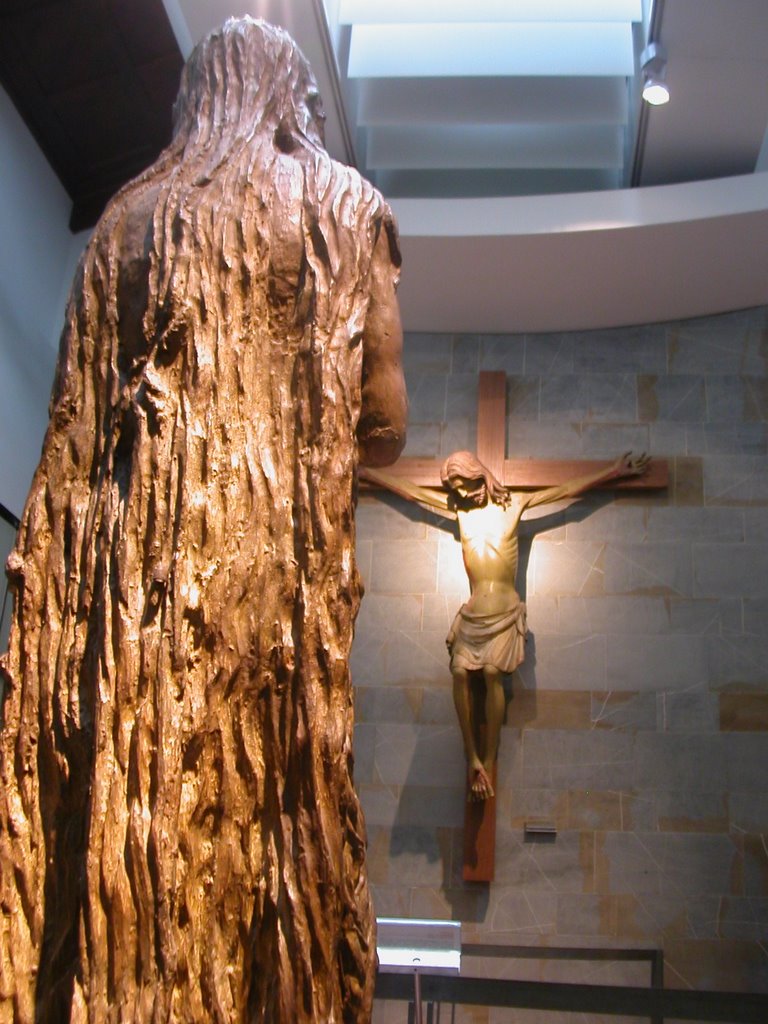 The museum has brilliantly curated her opposite a crucifix, showing that it is Jesus to whom she pleads with her gaze. The scriptures reveal that Mary Magdalene was healed by Jesus of demon possession and from that day forward was one of his most devoted followers. She was there at the cross and at the tomb and was a witness to his resurrection. Her life was transformed by his healing touch. Her story inspires me, and in Donatello's representation of her wretchedness I found both her despair and the joy of knowing that she was saved and her life transformed when her plea was met with the love and mercy of Jesus.
Wednesday, November 01, 2006
A Dream Deferred
It was seven years ago this month that I first realized that I was being called to become a pastor. The circumstances of that event and so many things that have followed have increased my certainty that this was a true experience, and that God is calling me, compelling me forward, to a life of ministry. I knew at the time that this meant years of preparation and I was okay with that. On the education side I went back to college, got a ministry degree, took a year off to catch my breath and then started seminary a year ago. On the ordination side things have been bumpier, for reasons I don’t feel like rehashing right now. But suffice it to say that ordination is still off in the future, and seminary will require at least two more years if I am able to continue full-time. So seven years have gone by, and I’m still in the ‘preparation’ stage.
I don’t feel bitter about this lengthy period of preparation. But my longing to be set free to plant a church and finally be doing what I feel such a calling to do has been sustained so long that it is threatening to turn to sorrow. A good friend of mine was trying to engage me in conversation about our dream church plant the other day and I found myself not wanting to talk about it. At some point it feels painful to keep dreaming about something that is still just out of reach. There are so many people I know or know of who need the kind of community that I dream about. When the mother of one of my daughter’s friends asks me if she can go to church with me, I feel so sad that I have no place to bring her. There is no way she can travel to the church we’re serving at in another city an hour away. And that church would not know what to do with this poor, broken, alcoholic woman with previous church abuse baggage. And there are others… I feel this desperation for the church I dream of to be a reality. But I still have to wait, deferring my dream until the kairos moment when it will be birthed into being.
I have great hope that this time will come in the not-too-distant future, and great joy that this dream is now shared with my future husband. But for now, it’s still time to wait and prepare.
I don’t feel bitter about this lengthy period of preparation. But my longing to be set free to plant a church and finally be doing what I feel such a calling to do has been sustained so long that it is threatening to turn to sorrow. A good friend of mine was trying to engage me in conversation about our dream church plant the other day and I found myself not wanting to talk about it. At some point it feels painful to keep dreaming about something that is still just out of reach. There are so many people I know or know of who need the kind of community that I dream about. When the mother of one of my daughter’s friends asks me if she can go to church with me, I feel so sad that I have no place to bring her. There is no way she can travel to the church we’re serving at in another city an hour away. And that church would not know what to do with this poor, broken, alcoholic woman with previous church abuse baggage. And there are others… I feel this desperation for the church I dream of to be a reality. But I still have to wait, deferring my dream until the kairos moment when it will be birthed into being.
I have great hope that this time will come in the not-too-distant future, and great joy that this dream is now shared with my future husband. But for now, it’s still time to wait and prepare.
A Dream Realized
This will be a more personal than theological entry and I thank you in advance for your indulgence. My scarce writing on this blog is largely because I’ve been busier than usual. In addition to the usual school, work, parenting routine I’m preparing to marry my fiancé, Josh Clark, in just two months! (http://www.joshandkarlene.com/) I’ve been single for over 8 years now with only a couple of less-than-wonderful dates in all that time, until meeting and falling in love with Josh a year ago. This weekend marks the anniversary of when we attended the Off-the-Map conference in Seattle and “it all started.” We’re leaving tomorrow to attend this same conference, and I guess I’m feeling reflective about how much things have changed this year.
I worked hard at not being a desperate single person, at not putting my life on hold to find a man, at not indulging in much self-pity, and in making a good life for my daughter and me. But even so, I remember poignantly how alone I would feel in my bed at night, exhausted from a long day’s responsibilities, longing for someone who could just help with the laundry. So many years of singleness after years of an empty marriage made me wonder sometimes what love was really like. I would watch my friends co-parenting their children in the way I might look at a National Geographic magazine portraying some foreign culture. And sometimes I would dream of meeting someone who would be the right fit for marrying a divorced-single-mother-pastor-church-planter with a pre-teen daughter, realizing that such a man might not exist.
So it was a year ago that I looked with wonder into the eyes of Josh Clark and started to realize that he just might exist after all. And I discovered with even more amazement that I could be the woman of someone else’s dreams too. As our lives are coming together I am finding the daily joy of watching a dream unfold – the dream of loving and being loved in return, the dream of sharing life with a wonderful person who makes a great partner in the daily working out of life and faith. I’m filled with gratitude and thankfulness that this dream has become reality!
I worked hard at not being a desperate single person, at not putting my life on hold to find a man, at not indulging in much self-pity, and in making a good life for my daughter and me. But even so, I remember poignantly how alone I would feel in my bed at night, exhausted from a long day’s responsibilities, longing for someone who could just help with the laundry. So many years of singleness after years of an empty marriage made me wonder sometimes what love was really like. I would watch my friends co-parenting their children in the way I might look at a National Geographic magazine portraying some foreign culture. And sometimes I would dream of meeting someone who would be the right fit for marrying a divorced-single-mother-pastor-church-planter with a pre-teen daughter, realizing that such a man might not exist.
So it was a year ago that I looked with wonder into the eyes of Josh Clark and started to realize that he just might exist after all. And I discovered with even more amazement that I could be the woman of someone else’s dreams too. As our lives are coming together I am finding the daily joy of watching a dream unfold – the dream of loving and being loved in return, the dream of sharing life with a wonderful person who makes a great partner in the daily working out of life and faith. I’m filled with gratitude and thankfulness that this dream has become reality!
Tuesday, July 25, 2006
Some Late Afternoon Thoughts on Church Culture
The other day I talked with a young woman who is being actively recruited by a Mormon church in town. She was invited by a friend, and she has found this particular church to be very inviting, caring, understanding and open to answering all her questions. She feels good there. She doesn't know or care much about theology, even though she identifies herself as a strong Christian. The love they are showing her and the genuine attention they are giving her are enough to make acceptable whatever theological claims they present to her. She has visited a number of orthodox Christian churches in town and none of them have appealed to her in the way that this Mormon congregation appeals. And to be honest, I completely understand. I can hardly blame her for caring more about the way she feels when she's there than about theological orthodoxy. I've been to most of the other churches she named. With one possible exception, I agree with her feelings about them. I wish very much that I had an alternative to offer her.
I spoke with another friend the other day who will have nothing to do with organized religion after being brought up in Christian schools and churches. She's been there, done that, and said "no, thanks." There are a handful of Christians she respects, but walking into a church with it's weird sub-culture and people who are products of that sub-culture is not something she will ever do. I can't blame her. I don't really like it either and I am one of those products of weird church sub-culture.
Over the years there have been times when I've invited people to attend church, and I've always been painfully aware of how strange church seemed to my friends. I've always wished that I could go to a church where it was really comfortable to invite people - where there wasn't this obvious cultural wall to climb and where the 'us-and-them' mentality was absent. I've always wanted to be a part of a church where I never had to fear embarrassment from what might be said or done by the pastor or worship leader, and where our church culture was the kind of thing that made people want to belong rather than want to flee. I've given up on finding one. I hope desperately that I'll be able to help pastor one.
As a pastor and seminarian, I care very deeply about theology. But these conversations have reminded me again that it's how we behave that matters most to others. As Jesus has taught us, it all comes down to love.
I spoke with another friend the other day who will have nothing to do with organized religion after being brought up in Christian schools and churches. She's been there, done that, and said "no, thanks." There are a handful of Christians she respects, but walking into a church with it's weird sub-culture and people who are products of that sub-culture is not something she will ever do. I can't blame her. I don't really like it either and I am one of those products of weird church sub-culture.
Over the years there have been times when I've invited people to attend church, and I've always been painfully aware of how strange church seemed to my friends. I've always wished that I could go to a church where it was really comfortable to invite people - where there wasn't this obvious cultural wall to climb and where the 'us-and-them' mentality was absent. I've always wanted to be a part of a church where I never had to fear embarrassment from what might be said or done by the pastor or worship leader, and where our church culture was the kind of thing that made people want to belong rather than want to flee. I've given up on finding one. I hope desperately that I'll be able to help pastor one.
As a pastor and seminarian, I care very deeply about theology. But these conversations have reminded me again that it's how we behave that matters most to others. As Jesus has taught us, it all comes down to love.
Tuesday, June 20, 2006
Divorce (Continued)
I assume that divorced ordinands are required to explain their theology of divorce, and the advice they would give for troubled marriages, because it is regularly observed that people's experiences influence their theology. As a Wesleyan denomination, we do value experience as part of the Quadrilateral, as it is held in tension with Scripture, Tradition, and Reason. It is much harder to be dogmatic and graceless for events that one has personally experienced. No one comes to the conversation about divorce objectively, whether or not they have experienced a divorce personally.
I believe that divorce is always a tragedy. It always results in and from people's brokenness, sin, and pain. Even when divorce is the best course of action in a particular situation, it is only better than some greater evil and not the best possible outcome for a marriage. Divorce breaks a covenant - a sacred vow - and the consequences within one's own soul and within one's community are far-reaching and devastating for such an action.
The Church traditionally sites two circumstances in which divorce is acceptable for a Christian - when one's spouse has committed adultery, and when one's spouse has abandoned the marriage. Recently, many Evangelicals have also come to accept divorce in cases of spousal abuse. While I affirm all three of these circumstances as justification for divorce, the decision to seek a divorce remains a highly contextualized decision that should be made with the guidance of the Holy Spirit, and with the counsel and support of Christian community. Even in 'justifiable' circumstances, the possibility for healing and reconciliation should not be ruled out quickly. Many marriages that seemed past hope have been restored, and as a pastor I hope never to give up too soon on the broken marriages of those I may counsel. In each situation, I will pray, listen, and seek understanding and the guidance of God's Spirit before ever lending my influence to someone's decisions in regard to marriage and divorce.
For those who are faced with the reality of the divorce, I hope to offer the grace of God and the hope of Christ. Divorce is both a tragic end, and a new beginning. As Christians we rejoice in the grace of God that brings healing to our broken lives and hope for new seasons of life following divorce. I hope to encourage people who have experienced divorce to throw themselves into healing, forgiveness and restoration as they seek God and discover God’s will anew in their lives. I am also passionate about the care of children who have experienced the divorce of their parents, and will encourage parents to attend to their children’s grief and recovery. As with others, those who are or have experienced divorce, need the community of believers to support and care for them, nurturing their faith, meeting their needs, and equipping them for the future. As a pastor who has gone through divorce, I am grateful to be able to offer the encouragement of personal experience as one who has been down the roads of both recovery and single-parenting with its tremendous joys and challenges.
Friday, June 16, 2006
Theology of Marriage and Divorce
Creation
At the beginning of Genesis, we find the story of Creation. According to the narrative, God created a human being. This person had a beautiful relationship with God, untroubled by any sin in which they would walk and talk together in the cool of the day. In spite of such peace with God and Creation, this person was deeply lonely and God recognized that this loneliness was not good. The result is the creation of the first woman, (at which time Adam is first identified as male). God created them for relationship with another - different and yet so similar that Adam declared "This one is bone of my bone, flesh of my flesh!" The post-Fall writer of this scripture chose to describe the essence of their relationship in this way, "They were naked and not ashamed."
The unity and un-selfconscious vulnerability and intimacy of this relationship contrasts sharply with the post-Fall reality. From that point up to the present day, relationships between women and men are now regularly characterized by shame, fear, hiding, and conflict. We are far from God's Creation ideal. "Your desire will be for your husband and he will rule over you." Power struggles are now part of the problem too, and from them emerges violence, oppression, and manipulation.
Marriage is intended to be the beautiful relationship described in pre-Fall Genesis, in which the pain of loneliness subsides in the beautiful union of husband and wife, who work, play and love alongside one another without fear and without shame. But since we are scarred by sin, we do experience pain, selfishness, fear, and shame. We hide parts of ourselves from one another. We hurt one another - sometimes deliberately. We struggle for power and control. And all these things make it difficult to trust, be vulnerable, and to live in forgiveness. Some of us have a harder time than others, but successful marriages always require the best we have to offer along with heavy doses of forgiveness since our best will still be far from perfect.
From the Creation account, we learn God's intention for relationships between men and women, and we learn how that intention has been distorted by sin. This should both inspire us, and give us pause to reflect on how we can live and love in this way. It should also humble us, as we realize how dependent we are on God's grace to live in this way.
Trinity and Marriage
From the Creation account we also learn that human beings are created in the image of God. Trinitarian theology teaches us about perichoresis - the divine dance in which the Creator, Redeemer and Comforter are both three and one. Each one is distinct in personality and cannot be subsumed into a single identity. And yet their unity is so complete that Christians are monotheists. We worship one God - a unified, three-person God.
"The two shall become one flesh." Scripture's description of marriage also describes a tension - a dance between unity and individuality within marriage. There are two people with distinct personalities, gifts, names, and bodies. And yet marriage makes them one - an unbroken mysterious unity that transcends their individuality without obliterating it.
Human sexual desire and our longing for marriage is rooted in our identity as beings made in the image of a tri-une God. Too much individuality in marriage, and the unity of the relationship may be compromised. Too little, and a person may be lost and de-humanized in the relationship. Healthy marriages are relationships of unity that respect the unique individuality of the persons within the marriage, and which manage this dynamic tension. Unhealthiness in marriage happens when one person tries to dominate or overpower the other person, or when either person is not free in the relationship. Brokenness also happens when either person becomes consumed with self-centeredness and destroys the unity of the marriage bond. As fallen ones, we all struggle with this tension between unity and individuality, between freedom and control, and between self-sacrifice and self-centeredness.
Covenantal Relationship
Marriage is a covenantal relationship - the most sacred of vows that a human being can make. In the Old Testament, making a covenant involved sacrificing an animal, cutting it into two pieces, and then walking between the halves of the animal. If one party broke the covenant, they were agreeing to share the fate of the animal. Obviously, such covenants were not entered into lightly and were broken only with disastrous consequences. Shockingly, God chooses to enter in a covenant relationship with Abraham and his offspring. When they broke the covenant over and over again, God remained faithful and eventually came as a human being to be sacrificed for them, to take on himself their consequence of breaking covenant with God.
Marriage is also a covenant relationship and in our culture we have no context for understanding the gravity of such a commitment. But scripture teaches us that there is a mysterious revelation of Christ's relationship to his Church within the relationship between a married couple. They are both covenantal relationships. Christ teaches us that faithfulness, forgiveness, and sacrificial love are marks of living in a covenantal relationship. And he teaches us that even when the other party fails, we must choose forgiveness and reconciliation. However, even Christ does not force others to love him or live in relationship with him. He offers everyone the freedom to accept his love, forgiveness, and sacrifice - or to reject him and all that he offers. The covenant is still a relationship of freedom, and marriage must also be a relationship of freedom. But where there is freedom, some will use it to break relationship. From this reality springs the tragedy of divorce. More thoughts on this to come...
At the beginning of Genesis, we find the story of Creation. According to the narrative, God created a human being. This person had a beautiful relationship with God, untroubled by any sin in which they would walk and talk together in the cool of the day. In spite of such peace with God and Creation, this person was deeply lonely and God recognized that this loneliness was not good. The result is the creation of the first woman, (at which time Adam is first identified as male). God created them for relationship with another - different and yet so similar that Adam declared "This one is bone of my bone, flesh of my flesh!" The post-Fall writer of this scripture chose to describe the essence of their relationship in this way, "They were naked and not ashamed."
The unity and un-selfconscious vulnerability and intimacy of this relationship contrasts sharply with the post-Fall reality. From that point up to the present day, relationships between women and men are now regularly characterized by shame, fear, hiding, and conflict. We are far from God's Creation ideal. "Your desire will be for your husband and he will rule over you." Power struggles are now part of the problem too, and from them emerges violence, oppression, and manipulation.
Marriage is intended to be the beautiful relationship described in pre-Fall Genesis, in which the pain of loneliness subsides in the beautiful union of husband and wife, who work, play and love alongside one another without fear and without shame. But since we are scarred by sin, we do experience pain, selfishness, fear, and shame. We hide parts of ourselves from one another. We hurt one another - sometimes deliberately. We struggle for power and control. And all these things make it difficult to trust, be vulnerable, and to live in forgiveness. Some of us have a harder time than others, but successful marriages always require the best we have to offer along with heavy doses of forgiveness since our best will still be far from perfect.
From the Creation account, we learn God's intention for relationships between men and women, and we learn how that intention has been distorted by sin. This should both inspire us, and give us pause to reflect on how we can live and love in this way. It should also humble us, as we realize how dependent we are on God's grace to live in this way.
Trinity and Marriage
From the Creation account we also learn that human beings are created in the image of God. Trinitarian theology teaches us about perichoresis - the divine dance in which the Creator, Redeemer and Comforter are both three and one. Each one is distinct in personality and cannot be subsumed into a single identity. And yet their unity is so complete that Christians are monotheists. We worship one God - a unified, three-person God.
"The two shall become one flesh." Scripture's description of marriage also describes a tension - a dance between unity and individuality within marriage. There are two people with distinct personalities, gifts, names, and bodies. And yet marriage makes them one - an unbroken mysterious unity that transcends their individuality without obliterating it.
Human sexual desire and our longing for marriage is rooted in our identity as beings made in the image of a tri-une God. Too much individuality in marriage, and the unity of the relationship may be compromised. Too little, and a person may be lost and de-humanized in the relationship. Healthy marriages are relationships of unity that respect the unique individuality of the persons within the marriage, and which manage this dynamic tension. Unhealthiness in marriage happens when one person tries to dominate or overpower the other person, or when either person is not free in the relationship. Brokenness also happens when either person becomes consumed with self-centeredness and destroys the unity of the marriage bond. As fallen ones, we all struggle with this tension between unity and individuality, between freedom and control, and between self-sacrifice and self-centeredness.
Covenantal Relationship
Marriage is a covenantal relationship - the most sacred of vows that a human being can make. In the Old Testament, making a covenant involved sacrificing an animal, cutting it into two pieces, and then walking between the halves of the animal. If one party broke the covenant, they were agreeing to share the fate of the animal. Obviously, such covenants were not entered into lightly and were broken only with disastrous consequences. Shockingly, God chooses to enter in a covenant relationship with Abraham and his offspring. When they broke the covenant over and over again, God remained faithful and eventually came as a human being to be sacrificed for them, to take on himself their consequence of breaking covenant with God.
Marriage is also a covenant relationship and in our culture we have no context for understanding the gravity of such a commitment. But scripture teaches us that there is a mysterious revelation of Christ's relationship to his Church within the relationship between a married couple. They are both covenantal relationships. Christ teaches us that faithfulness, forgiveness, and sacrificial love are marks of living in a covenantal relationship. And he teaches us that even when the other party fails, we must choose forgiveness and reconciliation. However, even Christ does not force others to love him or live in relationship with him. He offers everyone the freedom to accept his love, forgiveness, and sacrifice - or to reject him and all that he offers. The covenant is still a relationship of freedom, and marriage must also be a relationship of freedom. But where there is freedom, some will use it to break relationship. From this reality springs the tragedy of divorce. More thoughts on this to come...
Divorce Clearance
Since my last post, I became engaged to my wonderful fiance Josh, who I met in seminary. I could write at length about how wonderful he is, how fabulous our relationship is, and how great our engagement has been, but I'll try to stay closer to the topic of this blog, which is theological discussion, and spare you the mushy stuff. :o)
Josh and I have begun to build our future lives together and for us this includes dreaming shared dreams of ministry. These dreams include church-planting as co-pastors and we are excited for the day when we will be able to launch that adventure together. But for the time being we are focusing on serving wholeheartedly at Josh's church while we work toward ordination. For me, this has meant recently jumping back into the ordination process with my former (and now current) denomination. The ordination process is more complicated for me because I have to go through a process known as "Divorce Clearance." I can definitely understand why the denomination wants to know the circumstances of my divorce and why that has bearing on my fitness for ordination. However, it does seem that this process is flawed and unfair in many respects. Divorce is the only life event that is isolated for special consideration in the ordination process. I could have murdered, embezzled, smuggled drugs or prostituted myself, and the regular processes of ordination would be sufficient for me. But since I have gone through a divorce (which I did not want or choose and did everything in my power to prevent), I'm going to experience a much higher level of scrutiny than other ordinands. Josh has suggested that I wear a red letter "D" on my chest when I go for my DC interview with the bishop. :o)
One thing that I'm being asked to do, that other candidates are not asked to do, is to write an explanation of my theology of marriage, and how I would counsel others who are in difficult marital situations. I've decided to share this in my blog, even though it's probably too lengthy for this venue. But before I do, some questions to ponder about divorced people and ministry...
Just some food for thought, and now I will try to express my theology of marriage and divorce in the next post.
Josh and I have begun to build our future lives together and for us this includes dreaming shared dreams of ministry. These dreams include church-planting as co-pastors and we are excited for the day when we will be able to launch that adventure together. But for the time being we are focusing on serving wholeheartedly at Josh's church while we work toward ordination. For me, this has meant recently jumping back into the ordination process with my former (and now current) denomination. The ordination process is more complicated for me because I have to go through a process known as "Divorce Clearance." I can definitely understand why the denomination wants to know the circumstances of my divorce and why that has bearing on my fitness for ordination. However, it does seem that this process is flawed and unfair in many respects. Divorce is the only life event that is isolated for special consideration in the ordination process. I could have murdered, embezzled, smuggled drugs or prostituted myself, and the regular processes of ordination would be sufficient for me. But since I have gone through a divorce (which I did not want or choose and did everything in my power to prevent), I'm going to experience a much higher level of scrutiny than other ordinands. Josh has suggested that I wear a red letter "D" on my chest when I go for my DC interview with the bishop. :o)
One thing that I'm being asked to do, that other candidates are not asked to do, is to write an explanation of my theology of marriage, and how I would counsel others who are in difficult marital situations. I've decided to share this in my blog, even though it's probably too lengthy for this venue. But before I do, some questions to ponder about divorced people and ministry...
- What should irrovocably disqualify a person from pastoral ministry? What makes these disqualifiers more significant than other possible disqualifiers?
- Why does the Church single out divorce as it does? What is the Church communicating by doing this? (Nikky Cruz - made famous by David Wilkerson's The Cross and the Switchblade - was guilty of murder, drug dealing, leading a violent inner-city gang, and generally living a life of complete depravity prior to his conversion. He is ordained in good standing with a denomination that refuses to ordain any divorced person under any circumstances.)
- If the church takes divorce so seriously, why is the divorce rate higher among Christians?
Just some food for thought, and now I will try to express my theology of marriage and divorce in the next post.
Subscribe to:
Posts (Atom)
